
Sometimes the best way to get students excited about practicing math is to take the learning outside, give them room to move, and turn those math skills into an active game.
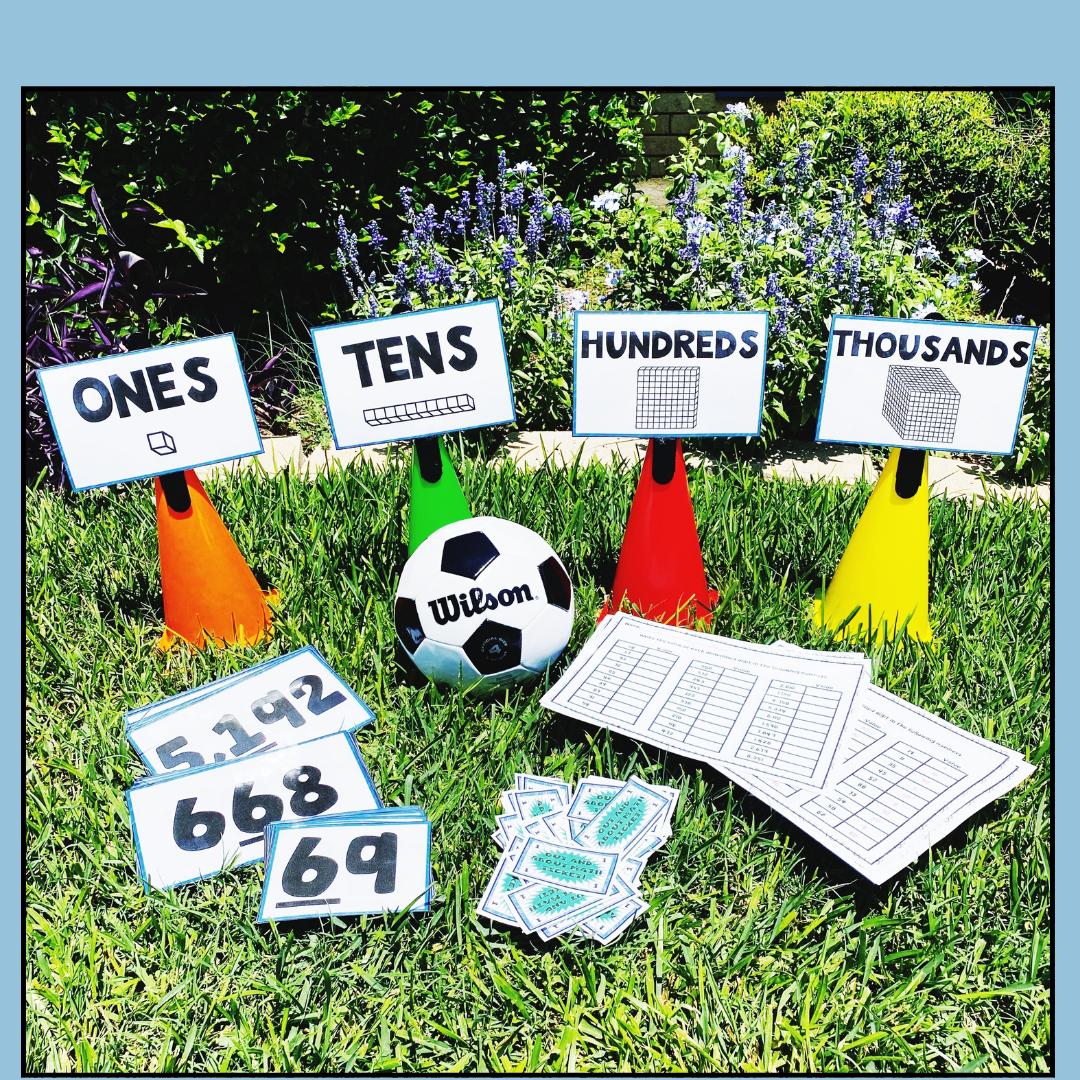
An outdoor number line game does exactly that. This active math game combines number sense, place value, estimation, comparing numbers, and mathematical reasoning with full-body movement. Students physically move along an outdoor number line as they work with number cards, making math review interactive, social, and fun!
Table of Contents
1. Why Take Math Review Outside?

Changing the learning environment can completely change the energy in a math lesson.
When students play this outdoor number line game, they move from the classroom to an outdoor space, and suddenly, they have room to move, collaborate, talk, and interact with math in a physical way.
Outdoor math activities give students an opportunity to step away from extended periods of sitting while continuing to practice important math skills. Movement is part of the math!
2. An Outdoor Number Line Game Gets Your Students Moving Their Entire Bodies

Children learn in many different ways!
Adding movement to math review gives students another way to engage with math ideas. Instead of simply looking at a number on a worksheet, students can physically represent its position.
For example, a student draws the number 275.
Rather than simply writing the number down, the student must look at the other number cards on the number line and think:
- What hundreds is it between?
- How close is it to 200?
- How close is it to 300?
- Where should it go on the number line?
- How can I explain my choice?
This outdoor number line game helps students see, estimate, discuss, and physically experience. This is one reason active math games can be such a useful addition to traditional math practice.
3. Outdoor Math Games Keep Math Review Fun and Engaging
Even students who have a fair understanding of number lines can become bored when they practice them exactly the same way day after day.
An outdoor number line game changes the experience. It can make repeated practice feel fresh, and it’s more challenging than you might think.
Students also have natural opportunities to talk about their mathematical thinking while they’re playing the game. Just because a student chooses a certain spot on the number line, doesn’t mean that student won’t have to shift to the left or right as other students come with their numbers. Discussions between students naturally happen as they agree or disagree with number placement.
You also have the opportunity to ask your students questions like:
- How did you know where that number belonged?
- What number should be closest to yours?
- Is your number greater than or less then the number on your right? What about on your left?
- Which digit in your number did you look at first when you were trying to figure out where to stand? Which digit did you look at next?
4. Start Your Outdoor Number Line Game With 2-Digit Numbers

If your students struggle with locating the position of numbers on a number line, start your number line game with 2-digit numbers.
This makes a great starting point for students who are developing their understanding of number lines, place value, comparing numbers, and the relative position of numbers on a number line.
I had students every year who struggled at the beginning of the school year with seeing number patterns and following the order of numbers on a number line. Starting out with reviewing 2-digit numbers gave them a stronger foudation to build their knowledge on…before we moved on to 3-digit numbers. By the end of the school year, students were locating 4-digit numbers on a number line.
5. Moving Up to 3-Digit Numbers Can Be a Bit of a Challenge

When students are ready for more of a challenge, bring out the 3-digit number cards.
This can be a bit of a challenge. I was surprised that this gave many of my students difficulty… but taking the time to continue practicing and discussing each misunderstanding made a huge difference!
Students have to think about hundreds, tens, AND ones. Before allowing students to race to their answer, ask them to estimate where their number belongs. Students can make their estimate and explain their reasoning before racing to their final location. Students determine which hundred their number is closest to and move toward that location. The physical distance between the numbers gives students a visual way to think about rounding.
6. Level Up to 4-Digit Numbers Later in the School Year

Leveling up to 4-digit numbers can take a while longer with second graders.
Their skills progress as they practice over the course of the school year. The great thing about this number line game is that students love to play it all year long. It’s a wonderful active way to review such an important, foundational math skill.
7. Using an Outdoor Number Line Game Benefits Many Other Math Skills
2-Digit Number Cards
Students can practice:
- Tens and ones
- Comparing numbers
- Ordering numbers
- Estimation
- Greater than and less than
3-Digit Number Cards
Students can practice
- Hundreds, tens, and ones
- Rounding
- Estimating location
- Comparing larger numbers
- Finding differences
- Ordering multiple numbers
4-Digit Number Cards
Students can practice:
- Thousands, hundreds, tens, and ones
- Large-number estimation
- Rounding to different place values
- Comparing and ordering 4-digit numbers
- Finding the distance between numbers
- Reasoning about number magnitude
8. Use the Outdoor Number Line Game for Different Purposes

One of the best things about an outdoor number line game is its flexibility.
- You can choose to use some of the cards during a math warm-up to get students thinking and moving in the classroom ath the beginning of a lesson.
- You can choose some of the cards as a review activity after teaching a skill.
- It can become a small-group math intervention activity when you want to work with a particular group of students.
- It can also be used as an outdoor math center or a fun end-of-week activity.
- And because you can observe where students place their numbers and listen to their explanations, it can provide valuable informal assessment
- One of my favorite ways to use the cards indoors was to hand them out to students (one by one) and have them line up from greatest to least or least to greatest as we prepared to head out to lunch, or specials, or just as practice at the end of the day. *Note* If you want to use the cards to line up before lunch or specials, give yourself extra time. As students get used to ordering numbers, it will go more smoothly- you’ll be amazed at how successful they eventually become at this skill!
9. Ready to Make Math Movement Part of Your Day?

If your students enjoy learning by doing, an outdoor number line game is a simple way to bring more movement, energy, and mathematical conversation into your day.
Start with 2-digit cards, build confidence, and then increase the challenge with 3-digit and 4-digit numbers.
10. You Can Make Outdoor Learning a Regular Part of Your School Year!

Why is math practice ALWAYS INDOORS?! It doesn’t have to be that way. Your students don’t have to be confined to learning inside the classroom day in and day out. They can get outdoors, get moving, and get to reviewing valuable math skills in active ways that are beneficial to all!
The year-long GROWING BUNDLE above can be an invaluable tool for your classroom. Each set contains differentiated levels of play that increase in difficulty. Your students will WANT to practice their math skills with these activities all year long. And as the school year goes on, you can bump up the level of each one of these games. The number line sprint game has cards from 2-digits to 4-digits with 4 different ways to play!
TAKE THE MATH OUTSIDE. GET STUDENTS MOVING. And let the learning happen one math game at a time!
Happy Learning!



















0