
If you teach 2nd grade math, you already know how powerful a number line can be for helping students truly see what’s happening when they add and subtract. Number lines take math from the abstract to the visual-helping kids build number sense, understand place value, and develop flexible strategies.
In this post, I would like to share six number line strategies for addition and subtraction that greatly helped my 2nd graders. Whether you’re introducing number lines for the first time or looking to extend your students’ mental math skills, these different approaches will give your learners the tools they need to succeed.
Table of Contents
1. Counting On (Addition)

- How it works:
- Start at the first number and count forward by ones until you’ve added the second number.
Example: 6 + 3 Start at 6 –> hop 1, 2, 3 spaces –> land on 9.
Best for: Small numbers, or when the second number is less than 10.
Why it works: It’s simple, visual, and great for reinforcing addition as a movement forward on the number line.
2. Counting Back (for Subtraction)

- How it works:
- Start at the first number and count backward by ones until you’ve subtracted the second number.
Example: 12 – 4 Start at 12 –> hop back 1, 2, 3, 4 –> land on 8.
Best for: Smaller subtraction problems, especially withing 20.
TEKS connection: Builds understanding of subtraction as “moving back” or “taking away.”
3. The Jump Strategy (Making Friendly Jumps)

- How it works:
- Students break numbers into tens and ones to make bigger “friendly” jumps on the number line.
Addition Example: 21 + 17 Start at 21, jump +10 to 31, then jump + 7 to 38.
Subtraction Example: 46 – 23 Start at 46, jump back -20 to 26, then jump back -3 to 23.
Why it works: Breaking number apart strengthens place value understanding and helps students work efficiently with larger numbers.
4. Bridging Through Tens

- How it works: Students jump to the nearest multiple of ten first, then add or subtract the rest.
Addition Example: 38 + 7 Start at 38, jump +2 to 40, then jump +5 to 45.
Subtraction Example: 52 – 6 Start at 52, jump back -2 to 50, then jump back -4 to 46.
Why it works: This strategy develops mental math fluency and builds confidence when working with tens.
5. Using an Open Number Line

- How it works:
- Students draw a blank number line and only mark the important numbers-starting point, jumps, and answer.
Example: 35 – 15 Students create a tick mark ( l ) and plot the number 35. Start at 35, and hop back -10 ( create a tick mark and number it 25 ), then hop back -5 more ( create a tick mark and number it 20 ). 20 is the final answer. No other tick marks or numbers are labeled on the number line.
Why it works: Open number lines encourage flexible thinking and allow students to solve problems in multiple ways.

6. Compensation Strategy

How it works: It adjusts number to make mental calculations easier, then corrects.
Examples: 46 + 29 Add 30 to get 76, subtract 1 –> 75 52 – 19 Subtract 20 to get 32, add 1 –> 33
Why it works: This strategy promotes number flexibility and shows students that there’s more than one way to solve a problem.
Why Solving Problems on Number Lines Matters in 2nd Grade

Number line strategies aren’t just about getting the right answer–they’re about building mathematical thinking. By teaching multiple approaches, you give students the freedom to choose the method that works best for them. This boosts confidence, deepens understanding, and prepares them for more complex math in later grades.
Teaching Tips for Adding and Subtracting on a Number Line

- Start with 2-digit problems before moving into 3-digit
- Use think-alouds to model jumping by place (ex. ” +100, +30, +4″) or ( +100, +10, +10, +10, +4″)
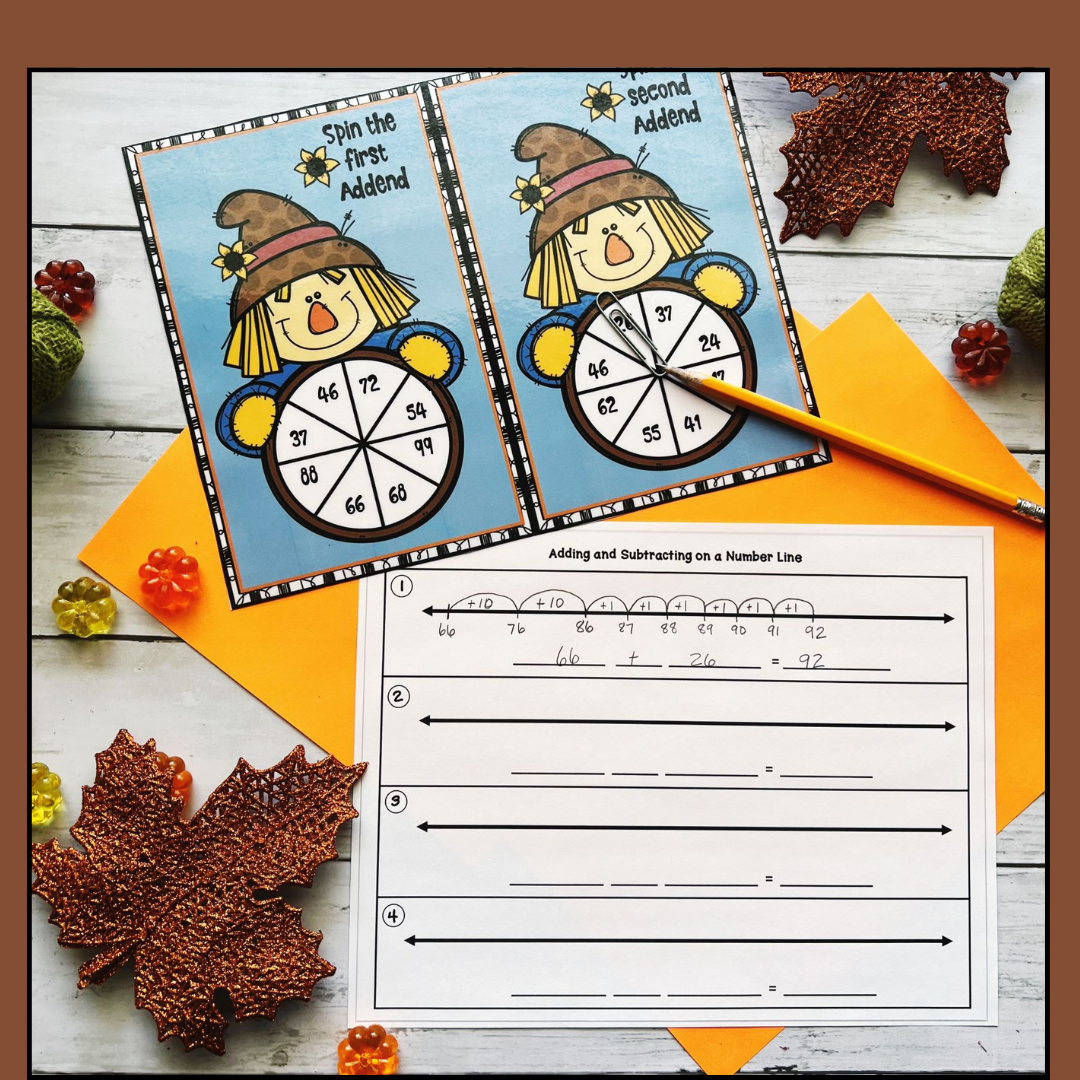
- Let students choose work with a partner and take turns spinning a problem that they both solve on their own number lines, then they compare their answers.
- Model jumping forwards and backwards on a large number line on the board (or butcher paper). Practice a few minutes each day. Discuss the fact that as you jump to the right, the numbers becomes greater–and as you jump to the left, the numbers become small or less.
- Call out a number each day, and have students continue counting forward or backward from that number. (This can even be done while students are standing in line for lunch or for the restroom)
- Practice mental math. Ask students. “What number is 100 more than 324? What number is 10 less than 133?” Increase the difficulty level as the school year progresses.
- All of these activities help students understand place value when they are adding and subtracting on a number line.
Want to use base ten block strategies along with your number line practice? Click here to read a blog post all about it!
Final Thoughts

Teaching students how to add and subtract on a number line transforms their understanding of place value and math reasoning. With this number line addition and subtraction resource, you’ll have everything you need to create a math block full of movement, critical thinking, and fun!
These hands-on activities are simple to prep, easy to differentiate, and powerful for building long-lasting math skills.


















2 thoughts on “6 Effective Number Line Strategies for Adding and Subtracting in 2nd Grade”