
Are you ready to dive into solids, liquids, and gases with your second graders? Teaching the properties of matter can be one of the most exciting and hands-on units in your science block! Every year that I taught it, my students would light up because it was so hands-on and easy for them to connect to the real world. I wanted to share how I break the unit down step-by-step, following the TEKS, so you can take it and make it work in your classroom.
Table of Contents
EASY HANDS-ON ACTIVITIES FOR EXPLORING THE PROPERTIES OF MATTER
1. Exploring the Physical Properties of Matter (TEKS 2.5A)

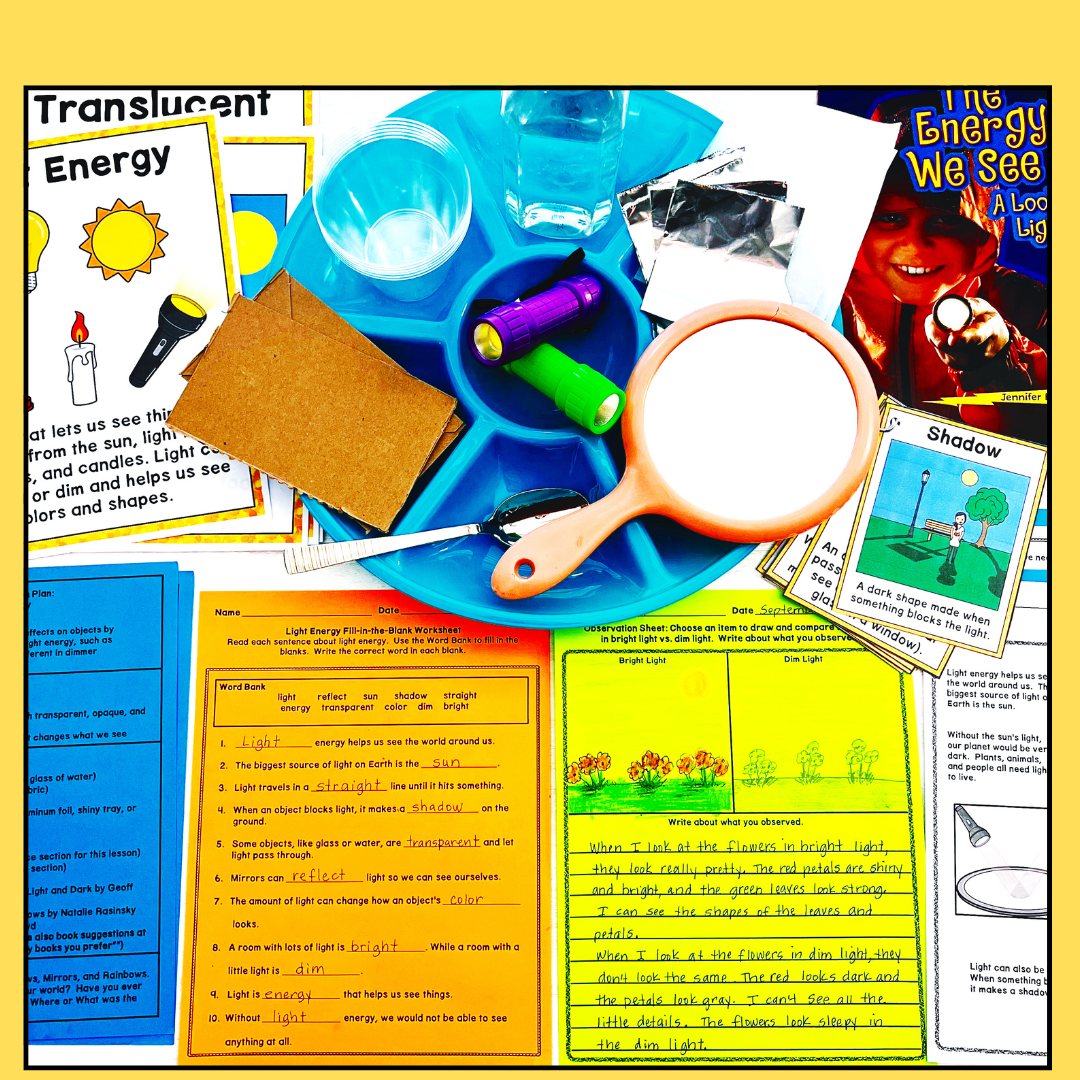
The basics are always a good place to start–getting kids to notice the properties of matter by exploring solids. Explore color, texture, hardness, and flexibility. You can set out trays with everyday objects–sponges, marbles, pieces of ribbon, pieces of wood, rocks–and have students describe their physical properties. Add inexpensive magnifying glasses for extra engagement!
You can let your students make up their own categories first. Then after they come up with their own, you can guide them to connect their ideas to science vocabulary. Suddenly, “soft and squishy” becomes flexible, and “bumpy” becomes rough texture. For students that need a little scaffolding, I have some “word bank” cards with several descriptive terms on them at each station.
Try making a class chart of the properties they discover and keep it up all year. You might be amazed at how often you refer back to it!
2. Solids, Liquids, and Gases (TEKS 2.5A)

- Solids Station – Students handle different solid items and describe their shape.
- Liquids Station – Students pour water, oil, and syrup into containers to compare flow speed.
- Gas Station – Balloons and bubbles make gases more “real” to them.
Create a three-column anchor chart where students glue or draw examples of solids, liquids, and gases. Then they create a “States of Matter Booklet”
3. Changes To the Properties of Matter Caused By Heating and Cooling (TEKS 2.5B)

Here’s when you get in some kitchen science. Show students how chocolate melts when heated and then hardens again when cooled You can do the same with ice–watching it melt into water and then freeze again.
What I love about this part is seeing then realize that heating and cooling don’t always change materials forever–sometimes changes to the properties of matter are reversible. You can talk about other examples, like butter melting or water boiling, and how those changes can be seen in everyday life.
Extension Ideas:
- Freeze different liquids and compare melting times.
- Place one ice cubes in the sun, one in the shade, and one in a container.
4. Changing Physical Properties of Matter by Doing things to Materials (TEKS 2.5C)

Once students understand properties, you can experiment with changing them. Students cut, fold, and sand paper, cardboard, and wood. Then take chocolate chips and melt them–because who doesn’t love edible science?
The discussion here will be so much fun–kids quickly see that the material is still the same, but the form or texture has changed.
5. Combining Materials for Stronger Structures (TEKS 2.5D)

Finally, we end with a STEM challenge: build the tallest tower possible using paper, tape, and straws.
Before they start, we talk about why combining materials is helpful. A straw alone isn’t strong, but several straws taped together, are sturdier. Tape and paper together can create bridges. They quickly realize materials can do more together than they can alone.
This step is a favorite because it blends engineering with science, and they get to justify why they chose their materials based on their properties.
Why This Unit Works So Well

The best thing about teaching matter this way is that it’s not just worksheets and vocabulary-it’s real, hands-on exploration. Students don’t just memorize the states of matter; they feel them, change them, and combine them!
By the end of the unit, they’re using terms like flexibility, texture, physical properties without even thinking about it. That’s when you know the learning has stuck!

Making It Easy
I’ve bundled all of these lessons, reading passages, vocabulary posters, and activities together so you can have it ready to go. If you want a science unit that’s interactive, standards-aligned, and fun, this matter unit will be a game-changer in your classroom.

And most of all… HAVE FUN LEARNING! You want to enjoy your time in the classroom and so do your students. I have tried to do all the extra work (except for collecting everyday items for experiments). Get students to help you set up, get them involved in the whole process, and they will LOVE the responsibility. Help your students understand why matter matters!
HAPPY LEARNING!!
Would you like to have your science units ready for the whole school year?– Lesson plans, Vocabulary Posters, Whole Group Science , Printables, and Grade Level Reading Passages with Questions and Answer Keys! It’s all in this AMAZING GROWING BUNDLE!–so you can grab it now at the lowest price of the year!















0