
Table of Contents
Teaching about the moon and the sun in second grade is a perfect opportunity to tap into students’ natural curiosity about space. When lessons are hands-on, visual, and connected to real-world observations, students dont’t just memorize facts, they understand patterns, movement, and why the sun and moon matter to life on Earth.
I hope you find that the activities below help your students learn all about the moon, it phases, and the sun’s importance, all while keeping engagement high and prep manageable.
1. Observe the Moon Over Time (Moon Phase Tracking)

One of the most effective ways for second graders to understand moon phases is through daily observation.
Students track the moon’s appearance over several day using:
- Simple moon journals
- Draw-and-label recording sheets
- Class anchor charts
This activity directly supports science standards that emphasize identifying patterns in the natural world. It also builds science vocabulary and encourages students to thing like scientists.
**Pair observations with short reading passages that explain why the moon appears to change.**
2. Model Moon Phases With Light and Objects

Abstract ideas become clear when we can see them. Simple materials like these tennis balls and flashlights can be used to model the phases of the Moon!
Using a light source and a spherical object, students model:
- How the moon reflects light
- Why we see different moon phases
- The connection between the sun, Earth, and moon
This activity works great in whole group or small groups and is aligned to the science standards related to objects in the sky and their movement.
**Hands-on modeling activities like this are included in my comprehensive moon unit**
3. Explore the Moon’s Surface Through Stations

Second graders love rotating through stations, and moon surface stations are especially engaging!
At each station, students explore:
- Craters
- Rocky surfaces
- How scientists study the moon
Stations may include images, models, sensory materials, or simple experiments that simulate impact craters. This aligns with standards focused on (observing and describing physical characteristics) such as those of objects in space.
**Vocabulary posters and visual references are especially helpful here for supporting science language.**
4. Build a Moon Model and Describe Its Features

Creating a physical model of the moon helps students connect vocabulary to real features.
Students:
- Build a moon model
- Add craters and texture
- Describe the surface using scientific terms
This activity integrates science and writing, which is a key expectation in second-grade standards.
**Make sure to give students clear expectations of how they are to use materials to create their moon projects. You may even want to create an anchor chart of the rules with them and call on students to model expectations. Also, be sure to model examples of students using accurate vocabulary during the activity. You will be amazed at your students’ science vocabulary after hands-on practice with the skill!**
5. Use Reading Passages to Reinforce Science Concepts

Second grade science standards emphasize reading informational texts alongside hands-on learning.
Short, student-friendly reading passages can explain:
- The moon’s surface
- The phases of the moon
- How the moon moves in relation to Earth
Pairing passages with comprehension questions helps students process what they observed during activities.
**Science resources that combine reading and experiments save time while reinforcing understanding.**
6. Teach What the Sun Is Made Of (Kid-Friendly Science)

Students better understand the moon when they understand the sun.
Second graders learn that:
- The sun is a star
- It is made of hot gases
- It gives light and heat
- The moon reflects the sun’s light
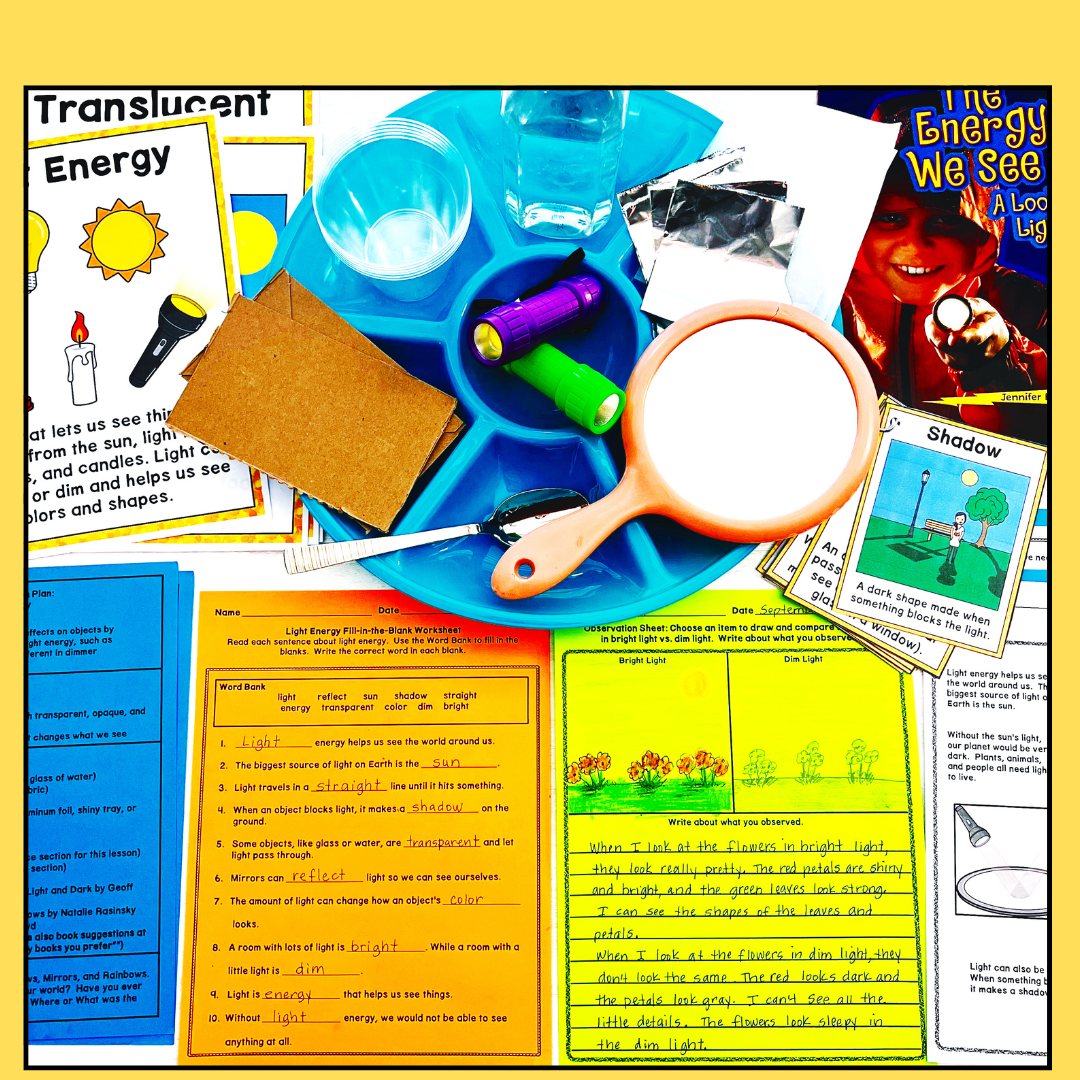
Visual demonstrations and diagrams help students grasp this concept without overwhelming them.
**Flashlights, visuals, and simple explanations keep the lesson developmentally appropriate.**
7. Demonstrate Why the Sun Is Important to Earth

This is one of the most important concepts in second-grade space science
Students explore how the sun:
- Provides light and warmth
- Helps plants grow
- Makes life on Earth possible
- Works with the Earth’s rotation to create day and night
Ideas include:
- Comparing temperatures in sun vs. shade
- Observing plant growth near sunlight
- Discussing what Earth would be like without the sun
- Exploring the Earth’s rotation and how that affects light received from the Sun (day and night)
- Exploring the Earth’s orbit around the Sun and how that affects the seasons
- Reading and discussing books about the Sun
- Reading standards-align science passages that support your students’ learning activities in the classroom
**These activities support standards related to cause and effect and the sun’s role in our environment.**
8. Connect the Sun, Earth, and Moon Together

Once students understand each object individually, it’s time to connect them.
Through models and guided discussion, students explore:
- How the sun’s light affects the moon
- Why the moon does not make its own light
- How the sun, Earth, and moon work together
This wrap-up activity helps students synthesize learning and strengthens conceptual understanding.
**Don’t forget to bring science books about each subject into your classroom lessons. My students LOVED to read books on science subjects that we were studying over and over again. Your school library is the perfect place to start. Have your students explore even deeper with books. There are all levels of books about the moon, its phases, the sun, and the Earth!**
Why Hands-On Space Science Works in 2nd Grade

Learning about the moon doesn’t and sun doesn’t have to feel abstract or overwhelming. When students observe, model, read, and build, they develop a true understanding of space science, one that sticks.
Second graders learn best when science is:
- Visual
- Interactive
- Repeated in different forms
Combining models, stations, reading passages, and vocabulary support ensures students meet science standards while staying engaged.
Final Thoughts

By engaging, standards-aligned activities and supportive instructional materials, teachers can create science experiences that are both rigorous and joyful for second graders.
I hope you enjoy these moon and sun activities! Science can be one of the most engaging and hands-on subjects in your classroom. If you are interested in reading about other Earth science activities, click here to read about ways to study the weather and seasons in your classroom!
Happy Learning!













0